Thursday, April 9, 2015

PARASHURAM KUND ( ARUNANCHAL PRADESH ) India

It is a shrine of all-India importance located in the lower reaches of the Lohit River. Thousands of pilgrims, visit the place in winter every year, especially on the Makar Sakaranti day for a holy dip in the sacred kund which is believed to wash away one's sins. The legend behind the belief recorded in the Kalika Purana, is that the great sage Parashuram washed away the sins of killing kshatriyas(cause the latter killed prashurams father and waged a war against brahmins) as he was a brahmin(cause it is not correct of a brahmin fighting a war or taking up sword), in the waters of Brahma kund.
HISTORY
The site of the Parashuram Kund as established by the sadhu was in existence till 1950 when the old site was completely changed by the earthquake that shook the whole of the North-East and the kund was completely covered. A very strong current is now flowing over the original site of the kund but massive boulders have in a mysterious way embedded themselves in a circular formation in the river bed thus forming another kund in place of the old

HISTORY OF KUMBH MELA


Kumbh Mela is considered as the most auspicious period of India. The origin of Kumbh Mela dates back to the time when Gods (Devtas) and Demons (Asura) resided on earth. Devtas were under the influence of a curse which aroused fear in them eventually making them weak and coward. Brahma (the creator) advised them to churn the milky ocean to obtain the elixir of immortality. The Mandara Mountain acted as the churning rod and Vasuki (king of serpents) was used as a rope for churning. Kumbh was the pot which consist the nectar of immortality and was recovered from Samudramanthan.
Devtas asked the help of demons for this sturdy task to complete with mutual agreement of sharing the elixir of immortality equally. They churned the ocean for 1000 years, where demons were holding Vasuki’s head and Gods were holding its tail. Finally after this entire churning process, Dhanwantari appeared with Kumbh in his palms. To prevent the amrita (elixir of immortality) from demons, its safety was entrusted to Gods Brahaspati, Surya, Shani and Chandra. After learning the conspiracy of the Devtas, demons turned vicious and attacked them. Devtas knew that demons possessed more power and can easily defeat them. The Devtas ran away with the Kumbh to hide it away and they were chased by Asuras. For 12 days and 12 nights the Gods were chased by Demons for the possession of Amrita. These 12 days of Gods are equivalent to 12 years of Humans. During this chase for the elixir of immortality the drops from Kumbh fell at four places – Allahabad,Haridwar, Ujjain and Nasik.  
Whereas some stories tells us that Demons were chased by Gods for 12 days and nights when the drops of amrita fell down from Kumbh at Allahabad, Haridwar, Nasik and Ujjain. In some mythological scriptures it is mentioned that the war between Gods and Demons in the sky lasted for twelve days for the possession of Amrita. To commemorate this holy event Maha Kumbh Mela is celebrated in every twelve years at the four sacred places where the drops from Kumbh were fallen.
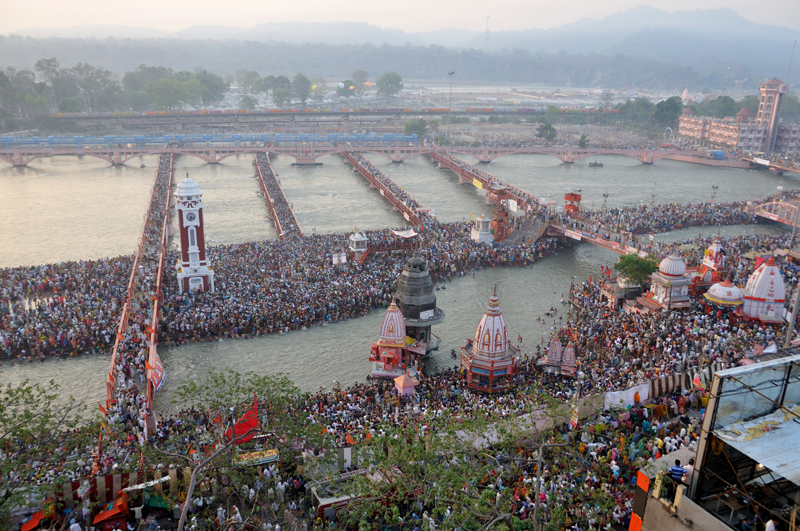
Kumbh Mela is the largest spiritual gathering in the world where millions of devotees takes a holy dip in the sacred water.
It is believed that the river turns itself into sanctity spots filled with primordial amrita at the historic moment of the Maha Kumbh Mela. The pilgrims get once in a lifetime chance to bathe in the spirit of holiness, auspiciousness and salvation.

KUMBH MELA IS CELEBRATED AT FOUR HOLY PLACES

  • HARIDWAR in Uttarakhand where the holy Ganga River enters the plains from the mighty Himalayas.
  • The sacred PRAYAGA (confluence) in Allahabad of Ganga, Yamuna and Saraswati
  • On the banks of Ksipra River at UJJAIN in Madhya Pradesh.
  • On the banks of Godavari River at NASIK in Maharashtra
http://kumbh-mela.euttaranchal.com/history-kumbha-mela.php


Vedic life in ancient India
CONCEPT OF AIR ‘VAYU’

 The observer space is the abode of matter particles, light space is the abode of energy and the intermediate space ‘Antariksha’ is the abode of field. The principal deity of Antariksha is Vayu. Jaiminiya Brahmana quotes,’ Vayu brightens in Antariksha.’ Field is another form of energy and, therefore, Yajurveda says,’ Vayu has penetrating brightness.’ The meaning of Vayu is made clear in Shatapatha Brahmana in the following Mantra, ‘Sun and rest of universe is woven in string. What is that string, that is Vayu.’ This verse clearly shows that here Vayu cannot mean air alone.

Apparent meaning of Vayu is air. The Vedic seers knew the importance of air for life. They understood all about air in the atmosphere and also about the air inside the body. The Taittiriya Upanishad throws light on five types of wind inside the body: Prana, Vrana, Apana, Udana and Samano Air resides in the body as life.Concept and significance of air is highlighted in Vedic verses.

Rigveda mentions³‘O Air! You are our father, the protector. Air has medicinal values ‘Let wind blow in the form of medicine and bring me welfare and happiness.’ Medicated air is the international physician that annihilates pollution and imparts health and hilarity, life and liveliness to people of the world. Hilly areas are full of medicated air consisted of herbal elements. Another verse describes characteristics of air³‘The air is the soul of all deities. It exists in all as life-breath. It can move everywhere. We cannot see it. Only one can hear its sound. We pray to air God. Ancient Indians, therefore, emphasized that the unpolluted, pure air is source of good health, happiness and long life. Vayu god is prayed to blow with its medicinal qualities.                      
           

Book:-Origin of Environmental Science From Vedas
Shashi Tiwari


.                  
Meaning of Namaskara in Hindu Tradition


In Hindu culture, people greet each other by joining their palms – termed as “Namaskar.” The general reason behind this tradition is that greeting by joining both the palms means respect. However, scientifically speaking, joining both hands ensures joining the tips of all the fingers together; which are denoted to the pressure points of eyes, ears, and mind. Pressing them together is said to activate the pressure points which helps us remember that person for a long time. And, no germs since we don’t make any physical contact!

Another aspect is that we dont only greet each other but we also greet the Soul inside his body. The soul which is meant to have direct connection with The Supersoul ,i.e.The God. 


Indus Valley Civilization

Wednesday, April 8, 2015

Significance of Holy Bath in the River Ganga


Taking a holy dip or bath in River Ganga is one of the most important rituals in Hinduism. Millions of Hindus perform the holy Ganga Snan during auspicious days and during Magh Mela and Kumbh Mela. The ritual is performed to achieve moksha or liberation and for redemption of sins. There is an interesting story which explains that mere Ganga Snan won’t wash away the sins or help in achieving Moksha.
Once Lord Shiva and Goddess Parvati was traveling on earth. Goddess Parvati saw thousands of people heading towards River Ganga to take holy bath as it was an auspicious day.

Goddess Parvati wondered whether all these people will attain Moksha or liberation by bathing in River Ganga. So she asked Lord Shiva – do you think all these people heading towards Ganga will attain Moksha?
Lord Shiva laughed and said that only a dozen or so among them will get Moksha. Only that person who has come with devotion and pious mind will get Moksha. Only those persons who will not commit any sin after the holy bath will get Moksha. Most of these people that are waiting to take a holy dip have come to perform it as a ritual and get over with a responsibility. Some are here to show off that they are religious minded.
Many of them are here to satisfy their ego of bathing inGanga.
Shiva said that one who is really yearning for Moksha will attain it here on this earth itself and for such people taking a dip and not taking one is of same value.
But Goddess Parvati argued that all the people here have come from far of places and they are spiritual, good and religious minded.
Shiva agreed to prove that He was right. Shiva disguised as a leper and Goddess Parvati disguised as his beautiful wife and went to the banks of Ganga. Goddess Parvati as wife started asking people to help her husband perform the Ganga Snan so that he will be cured of leprosy.
Majority of the people ignored her and went to take the holy dip. Some said some sentimental words and showed sympathy but did not help the leper perform the holy bath. Some advised the beautiful wife to leave the leper there and go home and get re-married. Some passed vulgar comments. Some asked her to get married to them.
After several hours and thousands of people passing by, a man came and helped the leper perform the holy bath. He remained silent and just said namaste to the wife and leper and went away.
Lord Shiva then said to Goddess Parvati that the man who helped the leper has already attained Moksha. He has already realized that all that is here is nothing but the Supreme Being. He is silent, calm and serene. For him a leper and handsome man is the same.

http://www.hindu-blog.com